Key Highlights
- Air New Zealand is introducing lie-flat sleep pods for economy and premium economy passengers on ultra-long-haul routes
- The concept, called Skynest, will debut on the Boeing 787-9 Dreamliner
- Passengers can book 4-hour sleep slots, starting at approx. NZ$495 (~£215)
- First routes include Auckland to New York, one of the world’s longest flights (~17 hours)
- Launch timeline: Bookings open 18 May 2026 | Flights from November 2026
Air travel, especially in economy class, has usually been associated with cramped spaces and restless journeys, but Air New Zealand is about to change this narrative. Recently, they announced the concept of the world’s first bunk beds in economy class for long-haul travelling, offering them the comfort which was confined to premium cabins.
Air New Zealand is preparing to roll out something that hasn’t quite been attempted at this scale before, dedicated sleeping pods for economy passengers. Not upgraded seats. Not extra legroom. Actual bunk-style beds.
The whole idea sounds ambitious, but it reflects a clear shift in how airlines are thinking about long-haul travel. The focus is no longer limited to premium cabins; improving the economy experience, particularly on ultra-long-haul routes, is becoming just as important.
What Exactly Is Skynest?
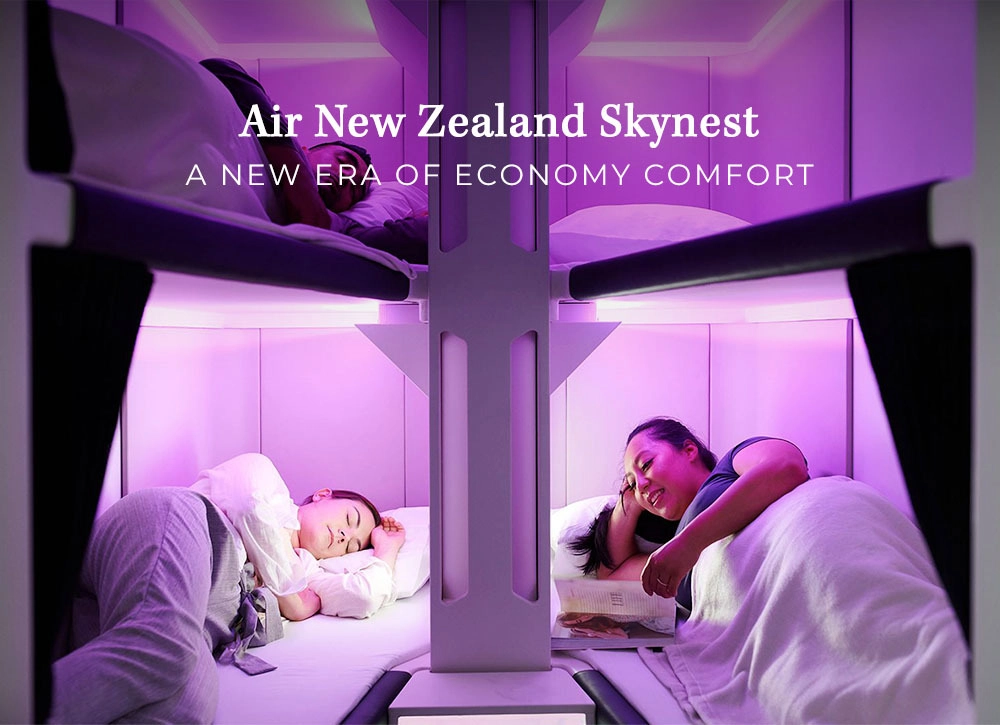
At its simplest, Economy Skynest is the first-ever separate sleeping zone inside the aircraft, designed specifically for economy and premium economy passengers (15 years and older), who want to rest properly during long flights.
Instead of trying to recline in your seat, you book a time slot and move to a set of six lie-flat pods (2 X 3 layout) installed within the cabin of the Boeing 787-9 Dreamliner (V5 configuration).
Nest Dimensions: Length: 203cm (6.6 feet/ 80 inches); Width: Approx. 64cm (25 inches) (at the shoulder); Height: 41cm (16 inches)
Skynest access: Nests are categorised by height: Top Nests (1 & 2) are 1.6m high, accessed via central steps; Middle Nests are 1m high, accessed standing; and Bottom Nests are at ground level (approx. 10cm), requiring bending to enter.
Note: Skynest access requires getting in and out on your own; it may include bending, kneeling, climbing, or crawling.
Each pod includes:
- A full-length flat bed
- Fresh bedding including sheets, blankets, and pillows for every session
- Privacy curtains
- Ambient lighting designed for rest and reading light
- USB charging ports
- “Nestcessities” amenity kit with essentials like eye masks, earplugs, socks, toothbrush & toothpaste and Aotea hand cream
There are limits, though. You won’t be sitting up in these pods. They’re built purely for sleeping, not lounging. Also, you have to wear socks while you are in bed.
How the Booking Works (And What You Should Know)
The concept sounds simple, but the logistics are quite structured.
- Each passenger can book one 4-hour session per flight
- Initially, there will be two sessions available per journey
- Pricing starts around NZ$495 (~£215) per slot
- Pods are available in addition to your standard economy ticket
There are also some clear rules:
- No sharing pods (even with family)
- No meals inside the sleeping area
- Strong fragrances are discouraged to maintain a pleasant environment
- Double-bunking is completely prohibited
It’s designed to feel controlled rather than chaotic, which matters when multiple passengers are using the same space.
Note: Refer to the nesting guide for the best Skynest experience and more.
Why This Matters More Than It Seems
On the surface, Skynest feels like a clever add-on. But look closer, and it’s part of a much bigger shift.
Ultra long-haul routes, especially flights like Auckland to New York (one of the longest commercial flights in the world), push the limits of what economy travel can realistically offer. Sitting upright for 15–17 hours is no longer just uncomfortable; it’s a deciding factor for many travellers.
By introducing sleep pods, Air New Zealand is addressing a problem that airlines have largely worked around rather than solved.
And they’re not alone.
- United Airlines Relax Row is exploring flexible seating concepts where passengers can convert rows into flat surfaces, and with a similar strategy, there is Air New Zealand Skycouch
- Qantas is planning wellness zones on its upcoming ultra-long-haul flights (Read on their official website to know in detail
Did You Know: Air New Zealand announced the development of Skynest first in 2020.
Bunk Beds Sleep Pods: Are They Really Worth It?
That depends on how you travel.
If you’re someone who:
- Struggles to sleep upright
- Arrives exhausted after long flights
- Values comfort over cost on certain journeys
Then yes, this could change how you approach long-haul travel entirely.
But it’s not for everyone.
You’re paying extra, and you’re sharing the experience with other passengers. It’s not the same as business class privacy or space. It sits somewhere in between.
Note: Skynest is positioned between Economy and Premium Economy cabins
Key Facts Before You Book Skynest
There are a few details that don’t get highlighted enough:
- You’ll still spend the majority of your flight in your regular seat
- There are six nests available for the six nesters at a given point in time
- Availability will be limited, especially on popular routes
- The experience depends heavily on timing (sleep slot allocation matters)
Final Thoughts
Skynest is all about making the long-haul economy more comfortable. It won’t replace premium cabins, but it offers a practical way to rest better without upgrading your ticket. And that alone changes the journey. Air New Zealand’s latest innovation is well worth considering if you value the feeling of being rested and recharged once you reach your final destination.
Frequently Asked Questions
- When will Air New Zealand’s Skynest launch?
Bookings are expected to open on 18 May 2026, with flights operating from late 2026 (as per reports: 26th November) - How much does a Skynest session cost?
Approximately NZ$495 (~£215) for a 4-hour session. - Can two people share a pod?
No, each pod is strictly for one passenger per session. - Which routes will feature Skynest first?
Initial rollout is expected on ultra-long-haul routes like Auckland to New York. - Is Skynest available for all passengers?
It is primarily designed for economy passengers, but availability will be limited per flight.